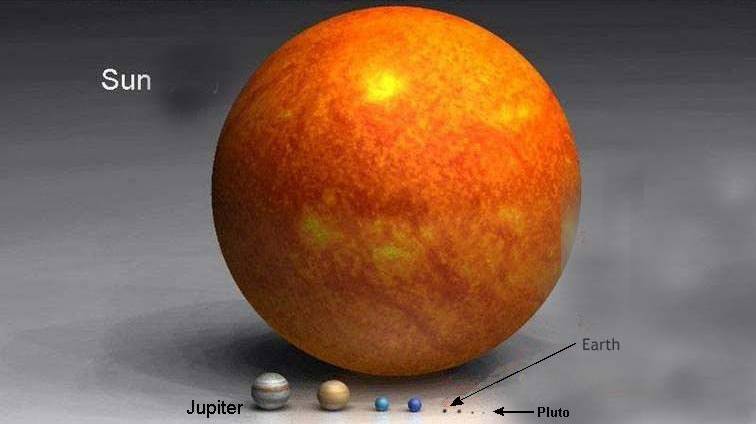
ASTB03 Great Moments in Astronomy. Fall 2022
This page has all the essential information on the in-person
course ASTB03, including syllabus, PDF lecture notes, home assignments, and other material.
No other pages, sites or docs (e.g.: Quercus, AccessAbility Service letters)
contain the current, updated & valid information.
Please check this site every week for updates & update your copy
of the files important to you. Power-outs do happen.
To stop covid, we should observe physical separation whenever possible.
In case you're seated next to another student(s) in class, we encourage you to use
medical masks (available for free at the building's entrance).
Brief description of the course
We explore numerous key events in astronomy (and astrophysics)
throughout the ages. While we pay much attention to the persons and stories
involved in the discoveries, human emotions and ambitions,
we also try to learn as much as we can about the Universe,
and witness the changes in the ways that science (exemplified by astronomy)
historically developed. The latter aim is actually more important than the
former.
Syllabus
Syllabus in TXT format contains the topics discussed on specific dates, and
the dates of assignments and exams.
Grading
Max. 100% score, breakdown:
4 Assignments, 30% = 7.5% each
Midterm 22% = 11%+11% (quiz + 1 written problem).
Final exam 48% = 24%+24% (quiz + 3 written problems).
Grading of the final score is standard for UofT:
minimum % for letter grades (for orientation only, since grades are reported as percentages):
A+ 90%, A 85%, A- 80%, B+ 77%, B 73%, B- 70%, C+ 67%, C 63%, C- 60%, D+ 57%, D 53%, D- 50%, F 49% or less.
Teacher and TA contacts
Prof. Pawel Artymowicz
office: SW 506G (old science bldg., 5th floor) - almost never there
during the pandemic except during office hours;
emergency contact: 416 3584275 (via text message to my cell phone)
email (the preferred way of contact): pawel /AT/ utsc.utoronto.ca, or
pawel.artymowicz /AT/ utoronto.ca
TA (marker): Aravind Shaj (aravind.shaj /AT/ mail.utoronto.ca).
First ask the TA, then the lecturer, if TA doesn't have the answer.
Lectures, office hours for ASTB03H3
Lectures: Mondays 7-9 pm in-person, MW120
Office hours: 6pm-7pm before the lectures in SW506G, other times by email.
Also, stay after lecture to ask any questions that may not be of interest to other
student. But if your question could be of interest to others, do not hesitate to
ask it during the lecture!).
This course does not follow a texbook, because there is no standard
texbook or even agreement on what constitues a Great Moment and what not.
Many supporting materials will be suggested below, but
none are required reading, unless stated explicitly.
Your presence during in-person lectures will not be
checked, enforced, or rewarded, but is very much recommended.
The lectures do not follow a single
textbook. Occasionally issues are outlined during lectures on
the blackboard that aren't described at length in lecture notes
(provided in pdf format below), or otherwise recorded.
Please take your own notes and ask for clarifications during
and/or after lecture.
Since the pandemic is still with us, to be extra helpful to those
who miss class, in the Media Gallery on Quercus or on our page
I will make available the recordings of online lectures from 2021.
(No guarantee that they fully overlap 2022 lectures, of course!)
FAQ
Is the course both online and in-person (Web Option)?
It is not online (notably, exams are in-person).
But if you miss a lecture, there will be substantial help,
as described in the previous subsection.
Is the exam open-book or closed-book?
It's closed books, but during exam you will be able to use self-written
note sheets (handwritten only; books/printouts & electronic communication are
not allowed). Up to 8 pages of own notes are allowed at
final exam, and 4 during midterm.
This way, you won't have to memorize so much.
In fact, you likely won't spend any time searching for the handwritten
information: you will simply remember the noted facts.
The dates of events are one thing that you may want to look up in your notes.
What material/knowledge is required for the exam?
All the lectures (the provided PDF notes, your own notes, recordings)
up to but not including the day of the exam
Are there separate time limits on quiz and written parts of
an exam?
No. You can do the quiz and written parts in the order you like,
there is only one overall time limit.
But we do advise to do the quiz first; it usually takes less time,
but gathers the same number of points as the written part.
Is there only one correct answer to each quiz question?
The quiz is multiple-choice. Clearly indicate your choice by
putting a mark # before letter a,b,c,d,e in front of your choice, e.g. [#b].
We don't intend more than 1 correct statement. Even if
more than 1 choice seems ok to you, mark only one answer that
seems best.
At the end of writing, please check that you solution booklet
or loose pages (if any) are signed with your student number.
Lecture notes and recordings
The 2021 recordings of audio and video can be viewed on Quercus,
Media Gallery tab located in the left column of the Quercus course page.
(L12 hasn't been recorded, please use lecture notes instead.
L13 was a midterm.)
Lecture notes from 2022 are provided here for your reference.
They do not replace attending lectures.
From experience, students who do not attend lectures get lower grades
because they are not able to fully understand the contents of the lecture
using only the provided slides. Recordins are better, but the best way
to learn is to regularly attend the lectures, ask questions and take
notes.
Virtually all videos from which you learn some small part of
the material in thus course will have URL to a Youtube video
mentioned in a PDF lecture. With most browsers the videos will start
after clicking the link in the .pdf file.
A few animations will be shown only in lectures.
Lectures
1 and 2 (PDF) ,
Lectures
3 and 4 (PDF) ,
Lectures
5 and 6 (PDF)
Lectures
7 and 8 (PDF) ,
Lectures
9 and 10 (PDF) ,
Lectures
11 and 12 (PDF)
Lectures
13 and 14 (PDF) ,
Lectures
15 and 16 (PDF) ,
Lectures
17 and 18 (PDF)
Lectures
19 and 20 (PDF) ,
Lectures
21 and 22 (PDF) ,
Lectures
23 and 24 (PDF)
Exams
Exams cover material discussed in lectures and assignments up to the week
prior to exam. To prepare, carefully read all the lecture notes
(pdf files posted on this page). Recordings from 2021 on Media gallery in Quercus
may help to clarify issues on which you may still have questions after studying the notes.
Prepare your own notes: 4 pages of own handwritten
notes are allowed during midterm exam,
8 9 pages during the final (this is the total
number of pages,
either single- or double-sided, and notice they cannot be printed or
photocopied, they have to be handwritten.
They need not be submitted with exam. You can keep the midterm notes for the final.)
Exams are in-person. No electronic devices are allowed. Booklets will be provided.
Exams consist of a Quiz part (mulitple-choice with 1 correct answer;
in case of doubt, choose the best answer), and written part.
The two parts contribute equally to the course
score, but the quiz is meant to take less time. Therefore, it probabaly makes sense to
start with solving the quiz. However, it's up to you to divide your time in
both the midterm and final exams.
In the exam booklet, you are encouraged to do drawings/sketches illustrating or
clarifying your answers to written questions.
Midterm exam
31 Oct, Mo, 20:05-21:00
Midterm is in-class, and replaces the second lecture.
Preparation.
Solutions of the 2021 midterm will be useful for you to review:
midterm with some solutions (text file).
Not all the questions and answers are shown.
The 2022 midterm quiz will have about 30 questions.
SOLUTIONS to midterm quiz and OUTLINES of solutions for
written part, 2022
Final exam 13 Dec, Tue, in MW160 9:00-12:00
As you recall, I wanted to change the time to 10:00-13:00.
You were happy with that. Unfortunately, it turns our we don't have
that option & have to
comply with the administration's timing above. We meet at 9:00!
Final exam will be an (almost) 3 hour in-person exam and follows the format and
difficulty level of the midterm.
1/3 of the questions in the final exam are about issues presented before the
midterm. This assures that before and after-midterm parts of
material are approximately equally represented in the two exams.
Preparation for final quiz questions is
in this file.
Final exam 2021 (online) with some solutions is in
this file
The final quiz will have up to about 55 questions.
Written part will contain essay-type tasks
(there were 2 in the midterm; there will be 3 somewhat longer in the final).
Solutions to quiz
questions are shown here
in this file.
Home assignments
Rules
You must respect the posted assignment submission deadline. (If you have a letter from
AccessAblity, you get the assignment earlier but have the same deadline).
Deadline time is the beginning of the lecture on a date posted in the
syllabus. There are no personal waivers of the deadline (extensions),
save for emergencies (report to, and ask the lecturer for an extension,
if you had one). However, we will accept late submissions via
Quercus with the following penalties:
up to 1 day late earns 75% of the mark, 2 days - 50%, 3 days - 25%, 4 or more - no credit.
After submitting assignment late by more than 1 day, please also
send a brief notice of this to the TA, giving your name + student
number & asking to mark your late work.
Those with the accommodation letters from AccessAbility Office will
get the text of the assignment 14 days before the deadline via email as accommodation.
Everybody else will be able to
download the assignment 9.79 days prior to deadline,
approximately :-), late evening around midnight on Fri.
Normal solving time will thus be
one week of workdays plus two weekends, ample time, given that assignments
are meant to be doable in 6+-1 days.
You are encouraged to ask clarifying questions about
assignments during the lecture one week before due date, or by email;
questions asked 2 hours before deadline are not guaranteed to be answered).
You will submit the 4 home assignments to Quercus section "Assignments". That section
allows you to upload files multiple times (if you have made corrections) before the
submission deadline. I believe you can also do late submission there; it will be
marked as late for our information. (If in trouble with submission, send email to TA).
Assignments should be either typeset in PDF form or handwritten and scanned, using phone,
camera or scanner, and then submitted as one file. Please do not submit paper copies.
It would be helpful if the file name of the upload should indicate the
number of the assignment and your 3 last digits of the student number.
For instance, assignment 1 of a student with student number 00123456
might be called A1-ASTB03-456.pdf. It's for our convenience, but
if you forget, it's ok.
Alternative file formats are .txt or .doc/.docx, they're also allowed,
although we prefer .pdf.
We definitely don't want to decode criptic formats sometimes produced by a smartphone.
If the assignment asks for, say, 2 to 4 pages, this means the number of pages
in electronic document (pdf) using a typical text file style i.e.
single-spaced, in reasonable (10pt to 12pt) font size. The count
includes illustrations, if any. Illustration can be by you or cited from
sources (with appropriate credit given).
Remember to always credit your sources at the end of the assignment in a
separare bibliography section. Use more than one source,
for instance a half of the references from book(s)
if appropriate, and the rest from internet pages (state the URL address
and name of the page in the literature listing). Do not include pictures
in your work that are not in public domain (e.g., wikimedia pictures cited
in wikipedia and NASA pictures are public domain, for instance),
for which you don't have copyright or owner's permission. That's the
general rule. But there is a loophole for us, academics. Both in the U.S.
and Canada the law allows a limited use (citing a part of work) for the
purpose of commenting on, criticizing, or parodying a copyrighted work.
That's called Fair Use (US) or Fair Dealing (Canada).
Use your rights! More info on how not to break copyright in
this FAQ and below.
However, you may commit plagiarism even if you don't break the copyright.
For instance, you cannot claim Fair Dealing if you just rip off a paragraph
from author's text literally, without quoting the source of this copied
paragraph. Never represent someone else's words as your own. Never cut and
paste text literally from wikipedia or any other source,
unless you list that source in bibliography (literature section).
Also, how much do you think we will appreciate your homework if most of it
consists of quotations (even if properly credited)? Do your own thinking and
writing.
Number the references in the text like so: "(...) as claimed by Aristotle[1]; that was in
contradiction to the later teachings of Newton[2]", then you'd list the
literature positions in bibliography below the text:
[1] Aristotle, "Physics", 400 BC, as quoted by some specific book
[2] Newton, I., "Mathematical Principles of Natural Philosophy" 1798 (Basel, 5th ed.)
You may alternatively use this style: "Copernicus (1543) claimed that....",
which allows you to order references alphabetically. This style looks nicer in print but
makes web page citations without obvious main authors more difficult, as you
may not know how to call the document and thus where to place it on the list.
In general, use your head, your brain and your mind[1] - a bunch of main citations
may be enough for a simple assignment on one topic only.
_____________________
[1] quotation from the movie "School of Rock" 2003 (excerpts
on Youtube service, URL = https://www.youtube.com/watch?v=QzBddN...)
Assignment 1. Ancient astronomy: The size of Earth.
(due late Tue 4 Oct)
[The deadline has been delayed by 1 day to allow full 10 days for solution!]
Research using books and internet a versatile ancient scholar
Erathostenes. Summarize briefly all the interesting scientific things he has done in
his life. Describe in more detail the following achievement: measurement of the
size of Earth. How was it done and from what sources do we know it?
What result was achieved, and with what precision, compared
with the currently known value? (Explain the method using high-school geometry,
the uncertainty of units of length used by Erathosthenes, if you are comparing results to
equatorial radius or an average radius of Earth assuming sphericity, or maybe you
compare circumference not radius - state everything clearly.)
Express the difference in percent, that is as a fraction of the modern value.
Do you consider the precision as a stroke of luck or genius?
Finally, consider the accuracy of his data: do you have any information or your own thoughts
on which parts of the calculation may contribute the most to the estimation error;
which assumptions made by Eratosthenes explicitly or implicitly may have been inaccurate?
Your PDF document should be 2 to 5 pages of your original writing including your original
drawings.
Assignment 2. Emergence of heliocentric system.
Due Mo 24 Oct (published 14 Oct)
Read Chapters 4, 5 and 6 of the book "Nicolaus Copernicus. Making the Earth a Planet"
by Owen Gingerich and James MacLachlan (Oxford U. Press), skipping the details about
the life of Copernicus (pages 53-56). You can get it from
https://ufile.io/381vq5f9
(the link will expire on Sunday before the deadline, download now.)
On about 4 pages (a recommendation that you don't have to strictly follow)
describe the following issues:
•
What motivated the medieval Islamic astronomers to change Ptolemy's model and in what way?
•
What is the "myth of epicycles upon epicycles"?
•
What motivated Copernicus to change Ptolemy's model and what two main changes he started
making at the time he wrote Commentariolus?
•
What role in Copernicus' considerations was played by the supposedly crystal spheres
in which planets moved according to ancient astronomy?
•
How was the absence of stellar parallax explained in Commentariolus? When was parallax
discovered and by whom (find out from sources other than Gingerich's book).
•
How was the periodic retrograde motion of planets explained, which planets perfom
the loops? In the Ptolemaic system, the sizes of the loops were governed by adjustable
parameters, chosen to fit observations. Was it different in the Copernican model?
Brief outline of solutions of A2.
Assignment 3. Discovery of helium
(due Mo 14 Nov, published Fri 4 Nov)
Please use internet resources to research and describe the interesting
history of discovery of helium, the second most abundant element in the
universe, which was first seen in stellar spectra, not in a chemial lab
on Earth like all other elements.
There is a large number of articles on that topic, but don't stop
at the first one you find, as it may just be most clicked on (recently),
not necessarily the most interesting or deep.
Find several sources, describe helium discovery and any other facts you
find interesting (related to the chemistry of the universe, not e.g.
the industrial uses of helium) but in the concluding remarks tell us why
you chose a particular source and not 2 others (please provide links to
those as well).
There is an interestingly told story in Smithsonian magazine on the
150th anniversary of the discovery in 2018, but we challenge you to find
something else that can compete with that article. If nothing else comes
close, you can use that article by Lorraine Boissoneault.
We hope that, if some part of the story gets your special interest, you
will find an additional source to expand the story beyond what you find
in the main source. Example: some recent use of spectroscopy to study
astronomical object(s) that have unusual abundance pattern of elements.
Expected length of your writeup is 3-4 pages with illustrations but,
as always, this is not a strict limit at either end.
Assignment 4. Two moments in modern observational
astronomy. (due 5 Dec, published Fri 25 Nov)
Study two moments, not exactly 'great' in all respects, but quite typical for the
way scientific inquiry actually works. Describe each on about 1.5 to 2 pages
or more if you include more than 1 or 2 illustrations.
(So, suggested minimum 3 pages of text in total.
Typed, but if you strongly prefer, hand-written+scanned.)
1. From chapter 6 of W. Wall's book "A history of Optical Telescopes", Springer 2018,
(download from UofT library in PDF form, or use shortcut).
Learn about the issue of the so-called canals on Mars, objects which were seen
by many optical observers (who? using what instruments?) in the 19th century,
but only some early 20th c. observers and nobody afterwards. Describe the story,
relevant other progress of observational astronomy, and implications. What
explanation of the phenomenon would you be willing to accept;
what provided the final resolution of the issue?
2. From chapter 8 of Wall's boook learn about the issue of the flawed mirror on
the Hubble Space Telescope. Describe the history of how it was discovered,
what caused it, and when and how it was remedied.
In both tasks, please augment your presentation with facts provided by at least
one online source of your choice (that is, find and cite some more information
on the two issues).
Plagiarism
Plagiarism automatically results in zero score for the whole assignment.
It constitues a serious academic offense, which must be reported by the TA or lecturer to
the administration. Chair's office must be notified as per UofT academic rules - study the
Code of Academic Behaviour of UTSC.
It is OK to discuss ideas on how to solve assignment tasks with other students or
friends. It is not OK to copy parts of your assignment from someone elses work, from
a web page etc. For example, if two students submit suspiciously closely worded and
structured assignment solutions, we do investigate & if a determination of plagiarism
is made (differences are superficial), then both students get zero mark for the
assignment (one that allowed his/her work to be copied and the one who copied).
Copying whole sentences from internet resources is of course not allowed in assignments
and is easily to detect thanks to the same Google that plagiarizer uses to find
the answer instead of understanding the issue and writing about it in own words.
If you want to cite someone else's work, use quotation marks for cited statements, then
give a reference in your text to the item in the reference list (bibliography).
[some of the students only provide bibliography at the end but no references in the text
- points will be subtracted for this!]
You don't have to always submit your own illustrations. You are free to give
reference to figures (citing URL in bibliography), whenever copying the graphics into your
work is allowed by the copyright laws. You can always place a link to other people's work
published on internet in your work, but rarely can you copy and paste their work into yours.
There are many exceptions to this restriction, for instance: the fair use clause in the
U.S., public domain materials, media commons, and all the pictures published by NASA
(NASA & some other sources explicitly grant you the use of their pictures).
Results so far
Preliminary results are available in
this text file.
Non-obligatory readings for those interested
Basic history and achievements of astronomy are described in a textbook ASTRO,
listed first. Others go deeper into the history and/or the discoveries.
In the first lecture I mentioned where you can find these books (UofT library,
libgen). Try them in electronic form, buy paperbacks if you like them.
□
"ASTRO, Canadian edition" by D. Backman, M. A. Seeds, S. Ghose and
V. Milosevic-Zdjelar (2012 or 2013). ISBN 017654626X
□
"1177 B.C. The year Civilization Collapsed" by Eric Cline (Princeton U. Press, 2014, 2021 rev. & updated)
□
"Plurality of Worlds. Origins of the Extraterrestrial Life Debate from
Democritus to Kant." by Steven J. Dick (Cambridge University Press 1984).
□
"The forgotten revolution. How science was born in 300BC and why it had to be reborn." by Lucio Russo (Springer, 2004)
□
"Growth of Physical Science" by James Jeans (Cambridge U. Press 1947 and newer ed)
□
"Early Astronomy" by Hugh Thurston (Springer, 1994)
□
"On the Revolutions. Nicolaus Copernicus complete works"
translated and commented by E. Rosen (Johns Hopkins Univ. Press, 1978)
□
"Uncentering the Earth. Copernicus and The Revolutions of the Heavenly Spheres"
by William Vollmann (Atlas Books, 2006)
□
"Nicolaus Copernicus. Making the Earth a Planet" by
O. Gingerich and J MacLachlan (Oxford U.Press, 2005)
□
"The book nobody read. Chasing the Revolutions of Nicolaus Copernicus"
by Owen Gingerich (Arrow Books, 2004)
□
"Tycho and Kepler: the unlikely partnership (...)" by Kitty Ferguson (Walker & Co., 2002)
□
"Kepler" (Dover Books on Astronomy, 1993)
□
"Galileo. A life" by James Reston, Jr. (Harper Collins, 1994)
□
"Galileo" by John Heilbron (Oxford University Press, 2010)
□
"Dialogue Concerning the Two Chief World Systems" by Galileo Galilei,
Albert Einstein (Foreword), John Heilbron (Introduction),
□
"Newton, A very short introduction", Rob Iliffe (Oxford 2007)
□
"On the shoulders of giants. The great works on physics and astronomy"
with commentary by Steven Hawking (Kopernik, Kepler, Galileo, Netwon,
Einstein) (2002) (1260pp.)
□
"William and Caroline Herschel [electronic resource] : pioneers in late 18th-century astronomy" by Michael Hoskin (Springer, 2014, UofT has it)
□
"James Lick's monument : the saga of Captain Richard Floyd and Lick Observatory"by Helen Wright (Cambridge University Press, 1987)
□
"Edwin Hubble, the discoverer of the big bang universe" by
A. S. Sharov, I. D. Novikov (Cambridge U. Press, 1993)
□
"The Cambridge Companion to Einstein" by Janssen amd Lehner
(Cambridge U. Press, 2014)
□
"Truth and beauty. Aesthetics and motivations in science" by
S. Chandrasekhar (U. Chicago Press, 1987)
□
"Lost in Math. How beauty leads physics astray" by Sabine Hossenfelder (2018;
see her youtube channel as well)
□
"The New Worlds. Extrasolar Planets" by
F. Casoli and T. Encranaz (Springer, 2005)
□
"A history of optical telescopes in astronomy" by W. Wall (2018)
Extra Material
[21 November 2022]
Tiny asteroid hit the Earth over Ontario
☆
https://twitter.com/i/status/1594024499862982658 has a brief
all-sky movie of a bright meteoroid (a tiny asteroid call 2022WJ1 burning in
the atmosphere roughly over Lake Ontario, thankfully
only < 1 m across. So the mass and energy released was how many times
less than the 10 km body (ficticious) in the movie "Don't Look up"?
Estimate to within an order of magnitude.
[Oct-Dec 2022]
What's interesting in the sky right now
☆
After twilight you'll easily see the bright planet Jupiter low in the south-east
sky (at midnight look more or less toward the south).
Saturn, which is about 16 times dimmer (becuse it's 2 times further than the otherwise
similarly-sized Jupiter), is located 40+ degrees west of Jupiter, i.e. to the right.
It will be going down sooner and sooner after dark.
If you have binoculars, make sure you look at both those giant planets.
You will see: (i) Galilean moons of Jupiter near it,
neatly arranged near one line;
(ii) that it is not a point object (the small disk of Jupiter);
(iii) the smaller Saturn with its famous rings, also discovered by Galileo.
☆
Mars rises a bit later than Jupiter.
It is making a loop in the sky that we discussed so much in connection with
Copernicus. It is now in the retrograde portion of its path on the sky, i.e. you and
I are overtaking the red planet in our orbital paths around the sun. In October,
we haven't caught up with Mars yet, i.e. did not cross Sun-Mars line just yet
(the opposition).
In October and November 2022 Mars is getting gradually closer to us and
therefore brighter (and bigger in a telescope, though I doubt you'll see much of
a detail on Mars surface with a small telescope or binoculars.)
But it's wonderful just to notice: its
reddish hue due to rust on the surface (iron oxide FeO like in the Moab
sandstone in Utah),
how it becomes brighter as it approaches opposition with the sun on 8th December,
and how it is rising in the East earlier and earlier every day (by 1.5, then more,
minutes). Mars does so, since it moves westward against the background of constellations,which themselves drift slowly westward with seasons, thus rising earlier and earlier
during the day. (Interesting is that Mars on 1 Dec 2022 will be closest and
brightest until 2033 - ahead by a week w.r.t. opposition.
That's because of eccentricity of Mars's orbit, and precisely
which phase of epicycle Mars is in, in Kopernik's model, during opposition.)
☆
What's more, there will be Mars occultation by the Moon on the 7th Dec. 2022.
Moon's parallax is very large, since it is so close. Seen from two opposite
sides of the Earth, Moon's position on the sky differs by up to 2 degrees of arc.
That's 4 diameters of the Moon. In comparison, parallax of Mars is some 50 times
smaller. Therefore the occultation will not be seen on the whole night-time surface.
From different points on Earth, the two objects will either overlap or not.
Fortunately for us in Canada, it will get really dark at 6pm and the occultation will
begin at half-past ten. Mars will disappear and then appear again behind
the thin unilluminated part of the Moon at about 22:29 and 23:17 (seen from Toronto).
The occultation will be seen easily (barring cloudiness) from your backyard,
since the objects are bright, you don't need a telescope, and Moon will be
about 65 degrees over horizon, in the south-east part of the sky.
More details here. TOO BAD, FORECAST IS CLOUDY SKIES :-(
Q:
Is it a coincidence that the lunar occultation of Mars almost exactly
coincides with its opposition with sun? Or is it always happening?
[2015]
Researchers have found rare satellite dwarf galaxies, and candidate dwarf galaxies, in orbit around our Milky Way, the largest number of such satellites ever found in one go.
read about it here
[2015]
A hi-res movie was created from tens of thousands of
frames sent to earth from the
space probe Cassini, which went into orbit around Saturn.
The original frames are black-and-white, taken through filters.
The color is restored using a computer on earth. NASA provides the data for such
public projects freely on their site. One day the creators of this GIF may
create a full-length IMAX movie. Notice that the spacecraft travels
through the Saturn system, the planet does not tilt that way itself.
Also notice the shadow of the planet on the rings and the thinness of the rings
(the true ratio is 10 m : 50000000 m)

[2014]
Image from ALMA, the Atacama Large Millimeter/submillimeter Array,
reveals extraordinarily fine detail that has never been seen before in the
planet-forming disc around a young star,
as announced by ALMA team.
[2013]
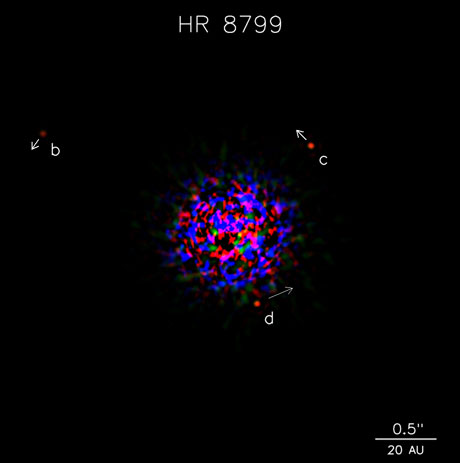
HR 8799 is a planetary system. The central colorful blob
covering the central star is an artifact of the method of imaging.
Three planets have been imaged in 2010 (red dots with arrows
indicating the direction and speed of relative motion). In fact, it
was the first multi-planetary system ever imaged.
Notice the scale in the lower right corner -- the planets are very far from their sun!
This planetary system is larger than our (out to Pluto).
[2012]
One of the nearest stars (see the table in Appendix to Backman textbook ASTRO)
is alpha Centauri, or α Cen. It has just been announced that measurements of its radial velocity with unprecedented precision resulted in a discovery of an Earth-mass planet near to it. Remarkably, a lot of Sci-Fi stories have already been written about humans traveling to a planetary system around α Cen.
[2012]
A cosmic orphan (of which there are many)
has been identified not too far from home: somewhat incorrectly the Telegraph calls it the 1st such discovery of a lonely planet in the Milky Way.
CFBDSIR2149 is “homeless” and does not orbit any star, rather it wanders around in the Galaxy alone.
[2012]
Mail Online reports on an imaging discovery made with the Subaru telescope atop Mauna Kea volcano in Hawai. 13 times more massive (not larger!) than Jupiter, the extrasolar planet is on the border of a class of objects known as brown dwarfs (failed stars). It circles a star kappa Andromedae, which is
2.5 more massive than the sun. This blog is actually a better description of the planet.
Useful or just interesting links:
-
1. Solar Views = more multimedia including some movies, link
-
2. The extrasolar planets Wiki, link
-
3. The Extrasolar Planets Encyclopaedia, link
-
4. Richard Feynman - exerpts of a
lecture on gravitation
-
5. Giant Planets Orbiting Faraway Stars - an article by Geof Marcy and paul Butler, link
-
6. Exploring New Worlds - an article by Ron Cowen, link
-
7. The Swiss site about exoplanets, link
-
8. A leading astronomical article/abstract database ADS from Harvard, link
-
9. Maps of our Solar System bodies, link
-
10. Solar System Orrery, link
-
11. New STScI press releases, link
-
12. STScI Digital Sky Survey search form. Input ANY object's designation to get coordinates and .GIF picture,
link
-
13. NASA and its Mars rovers
link
-
14. KITP/UCSB 2004 conference on Planet Formation (abstracts, streaming audio & video) link
-
15. The new, slightly controversial definition of a planet,
link
-
16. Upper mass limit for stars upheld!, link
...or maybe at 140 solar masses
-
17. First image of a planet around a sun-like star: link
-
18. First image of
three planets around HR 8799 (also on
wiki)
-
19. A bizarre sprinkler object: a dying star LL Pegasi in the constellation of a winged horse
link (also here) .
-
20. A remarkably rich planetary system around HD 10180 (announced Aug 2010): 6+ superearths with no known giants
link1,
link2
-
21. Young stars with planet-forming disks in Orion
link1,
and listen to some theoretical concepts in
link2,
-
22. Artist's conception of a hot Jupiter HD209458b,
link,
-
23.
Sun and planets to scale
-
24. The discovery announcement of an Earth-mass planet in
Alpha Centauri system (the nearest star)
-
25. Contributions of Robert Hooke: Universal Gravity and Dynamics
article (PDF)
-
26. A catalog of astronomy apps for mobile devices
article (PDF)
-
27. News from the Beta Picoris: the disk has concentrated CO feature
online article
-
28. The golden age of neutron-star astrophysics
Nature; news feature March 2020
-
29. Richard Feynman - exerpts of a
lecture on scientific method
-
30. Best of Øfdream
with sky views
The local home page
of Pawel Artymowicz
Last modified: Nov 2022