ASTC25 Astrophysics of Planetary Systems 2027
This page (http://planets.utsc.utoronto.ca/%7Epawel/ASTC25)
together with the syllabus and other subpages are the official sources of
information on this in-person course. It provides lecture notes, home
assignments, prelim. results and other material. Check/redownload regularly.
Quercus provides a Media Gallery and a section to submit assignments.
It will be used to broadcast to you anouncements via email.
However, Quercus does not have important updates, or explain all the
rules of ASTC25. Please do not send messages from Quercus to us, use
only your utoronto email.
Syllabus
This file is an authoritative listing of topics, dates, and locations
of lectures, assignments, and exams. Re-download every week!
If some dates are in disagreement with other files/pages, please
notify the lecturer.
General information
Welcome to the upper-undergraduate course on planetary astrophysics
for science students. Topics cover a broad range from orbital mechanics to
the dynamical origin of planets, to the discovery of planets outside the
solar system (see syllabus).
In ASTC25, we empahasize theory, but confront its predictions with
observations, including some of the newest discoveries. Part of
course deals with small bedies like asteroids, comets and dust. They
are an important part of the dusty disks of solar and extrasolar
planetary systems. Click on these illustrations of the fascinating
small visitors from the Oort cloud and the Galaxy:

LEFT:
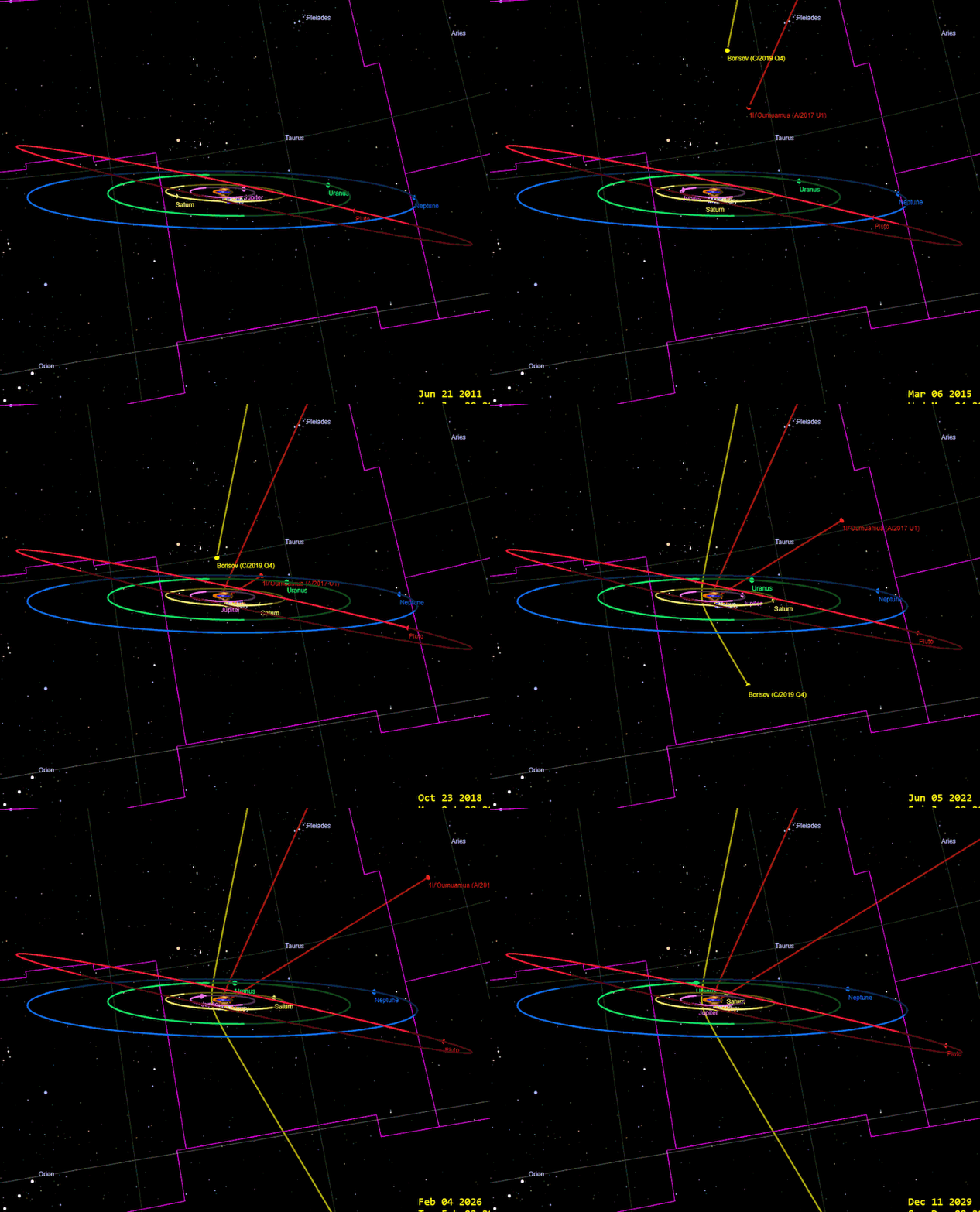
The red trajectory shows the 1st known visitor from interstellar space
(hence 1I in the name) called 1I/2017 U1 (Oumuamua). Discovered in 2017 by a
military Pan-STARRS 1 telescope in Hawaii at a distance of 0.22 AU from Earth,
the small object came from the direction of the constellation Lyra, cruising
through interstellar space at 26.33 km/s. Its classification as a small comet
vs. asteroid ejected from another planetary system has changed over time:
c,a,c,neither. The second, much larger interstellar object shown by yellow
line, is the 2I/Borisov comet. It's speed in space (32.2 km/s) and the
perihelion distance (2AU) are larger, therefore the deflection angle after
flyby is much smaller than 1I's. As luck would have it, Borisov's comet came
shortly after Oumuamua in 2019.
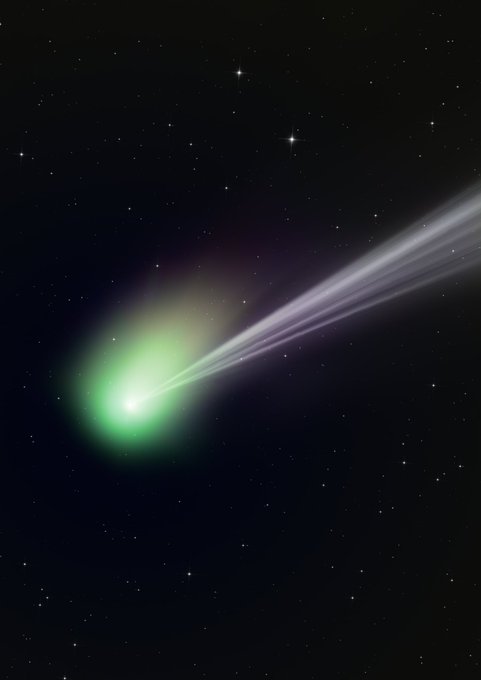
CENTER LEFT: A visitor from Oort Cloud was spotted in March 2022 by Californian
astronomers. The Green Comet or C/2022 E3 (ZTF) flew closest to us on 1 Feb
2023, at a safe distance of 0.28 AU. Green light was due to a complex
interaction of UV sunlight with C2 molecules it ejected (among
others). This comet was initially classified as an asteroid, and may or may not
become interstellar after this passage through the inner Solar System.
CENTER RIGHT: A large (up to 9 km radius) Oort cloud comet C/2017 K2 PanSTARRS,
passing by stellar cluster M10 in 2022 near its 1.797 AU perihelion.
On nearly-parabolic inbound orbit (aphelion ~50000 AU), it started outgassing
& creating coma early on (beyond the distance of Saturn), probably due to the
CO ice sublimation.
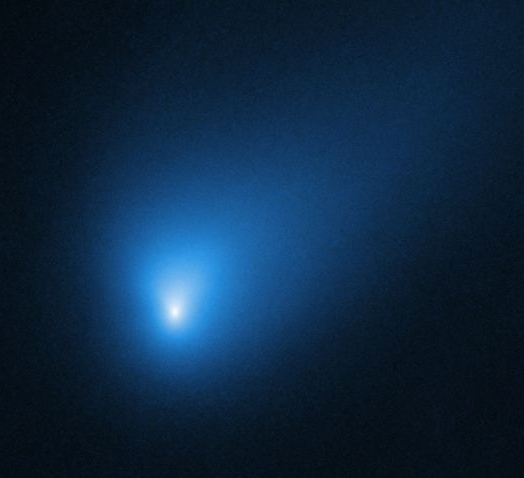
RIGHT: The 3rd interstellar visitor seen so far, comet I3/ATLAS, was
discovered 1 July 2025 by the global, robotic Asteroid Terrestrial-impact
Last Alert System (ATLAS).
See this image by
Gemini South telescope in Chile). Despite the perihelium at 1.35 AU its
trajectory was only very weakly bent (high e=6.13941) on account of
large interstellar speed of 58 km/s. Both the 1st and the 3rd interstellar
visitors elicited numerous baseless explanations as alien spaceships, even
by a professional astronomer (Avi Loeb) and a physicist/writer (Michio Kaku).
At the end, the course introduces you to basic astrobiology concepts.
Course and textbook
Planetary system science is developing quickly. Appropriate, all-encompassing,
textbooks at the upper undergraduate level are few and far between. Therefore
I mostly teach from own notes. Behind the scenes I use my textbook, which has
no English edition. Almost everything I want you to understand and know, I put
into the lectures (recordings available on Quercus) and lecture notes (PDF).
What you learn in the lectures should partially prepare you for the written
problems found in the homeworks (assignment sets 1-4) and the exams. I very
strongly encourage attendance at lectures, taking your own notes, and asking
questions during lectures (feel free to interrupt me) or after lectures.
If you don't engage in this way, you may find it difficult to undestand the
subjects - for instance, recordings don't capture well the classroom
drawings made on blackboard.
I also mix in some material from this widely-accessible textbook.
"Fundamental Planetary Science: Physics, Chemistry and Habitability"
by Jack J. Lissauer and Imke de Pater (2013, 2019). I will mention where
to find the book in the tutorial.
You don't have to read the whole textbook. Several chapters might give you
another angle on or another wording of issues than Lectures, but they are not
a required reading. Only Chapter 15 is obligatory, please study it.
Be careful not to confuse it with "Planetary Sciences" (by the
same authors), which is a different, graduate-level, version book I mention
in the section on other books, below.
Other books
There are some
other books worth reading listed on a subpage.
They are not obligatory but some you may find them interesting, and can be
good choices for extracurricular reading. See about activity points below.
Marking Scheme:
4 sets of home assignments: 30% (7.5% each set)
midterm: 21% (11% problems + 10% quiz)
final exam: 46% (23% problems + 23% test)
class/tutorial partic. & activity*) : up to 6%
Max points: 100%.
Grading is standard: minimum percentage marks for letter grades
(for orientation only, since grades are reported as percentages)
A+ 90%, A 85%, A- 80%, B+ 77%, B 73%, B- 70%, C+ 67%, C 63%, C- 60%,
D+ 57%, D 53%, D- 50%, F 49% or less.
*) Up to 3 activity points will be awarded for activity during lectures and
tutorials (asking questions). Full 4 points will only be awarded for coming
to an office hour and successfully sharing your knowledge gained from an
optional book. The level of the book must be appropriate, subject should
concern planetary systems. Examples of appropriate books are linked in the
Other Books section above.
For pre-approval, email me the author and title of a book
that is not on the list of recommended books, or show me during a break.
Contact information including emergencies & office hours
Please mention ASTC25 in subject line, or your mail may get lost.
Lecturer: Pawel Artymowicz, email:
pawel.artymowicz AT utoronto.ca, 416-3584275 (please text).
TA (marking & email answering):
TBA
Preferably use mail.utoronto.ca service, avoid sending mail from gmail. UTSC
mailer has problems with responding to gmail. Please mention your student number
when discussing your personal questions or marks (the temporary results file
only lists the last digits of your student number, not your name.)
Do not send email or comments to me via Quercus (I rarely check things
there, and it's impossible for me to reply.)
Office hours: between lecture and tutorial & immediately after tutorial.
Homework problems
General info
The format and the way of submission of solutions is electronic: take
readable snapshots or scans of *neatly* hand-written, numbered pages,
indicating your student number. Convert to one .pdf document. (If you hate
handwriting, you can typeset your solutions and upload them as .pdf or .doc
but then you will have to spend extra time doing the sketches/diagrams which
you'd otherwise quickly do by hand.) You submit your term work to
Quercus/Assignments before the deadline posted in the syllabus. Your TA will
be an authority on this process. Your solutions may be checked for possible
plagiarism (i.e., overlap with fellow student's work or with internet pages;
if you quote online resources, clearly reference the source).
Please remember to number the pages and sign all of them with your name and
last 3 digits of student number, say, "...123". Write legibly; very messy
homeworks cannot be graded. Please give enough details IN WORDS of the
solution procedure. It's as important as the correct final answer. And don't
forget to follow the guidelines on what a decent solution must contain (below)
such as checking physical units.
Everything you submit and the comments by the marking TA will be visible on
Quercus. It will allow multiple submission of the files before deadline, so
if you have corrections to your solution please post an updated file before
the deadline (so it's not marked as late).
You will be able to see and check a computational/calculational solution
against a published one. This will make long explanations by the marker (TA)
unnecessary, so don't expect very detailed comments on Quercus. Individual
problems will have a nominal point value displayed, and the TA will report
your marks relative to these max scores. But the eventual "out of" or maximum
score for a given task will be decided by the lecturer, and sometimes
slightly re-adjusted toward the end of the course in your favor. Check the
preliminary results file further down on this web page. The "out of" line
gives the number of points yielding 100% mark for a given task.
What steps are required for full solution?
A fully solved problem may require all of the following steps:
- A sketch of the situation
- Analytical part - manipulation of symbols to find the
required relationships between quantities
- Units checks
- If units are ok (then & only then) substitute the constants and
values, calculate the results
- Decide whether results make sense (e.g., is the order of magnitude ok?)
- Write up final version legibly and clearly, put student # on the 1st page.
Explain in words what you're doing, don't just write equations.
The same applies to written problems in exams.
Of course, some problems may not require pts. 1, 3, and/or 4.
Deadlines. Time: the beginning of first lecture (13:00).
The intention is to give you 8-9 days to solve problems really meant to be
done in 7 days. But don't put the work away until the last days. This often
creates big problems. Plan ahead for a timely submission of solutions. Quercus
flags any late submission and tells us exactly when you submitted it. Late by
10 minutes? We will accept it, assuming technical problems. (Start submitting
sufficiently early, if your network has problems.)
There are no extensions for assignments.
It is both because of the fairness to all those who respect deadlines, and the
pedagogic needs (right after the deadline we post and/or discuss solutions in
the tutorial.) AccessAbility students will receive an accommodation consisting
of 12-13 days to solve assignment.
Either late submission or point transfer will be done at the discretion of
the professor only in proven medical or personal or family
emergency/bereavement, which you will need to prove in the
University-prescribed way [either Absence (Self-)Declaration via ACORN,
only 1 week allowed per term, or University Verification of Student
Illness/Injury (VOI), which is a doctor's note. Send me the document.]
Likewise, a special treatment will be extended to justified & documented
absence at midterm. There are no deferred midterms in ASTC25. Points will
be transferred to final exam; you must submit a self-declaration on
Acorn and send me a copy, see
this page).
Please do not ask for individual extensions because of assignments/exams in
other courses - such circumstances are not emergencies, not a sufficient
ground for exceptions, and granting them would be unfair to others.
Work in other courses should be known and taken by you into account ahead of
time. Use the extra 2 days you have to solve any scheduling problems.
🤔 Four problem sets
If there are misprints or anything else unclear about the problem set and/or
access to it, please ask immediately and allow up to a day for an answer. It
is too late to ask one day before the due date.
Set A1. Due Thu 28 Jan. Formulation
Prob. set 1, PDF . Solutions :
cf. this PDF .
Set A2. Due Thu 11 Feb. Formulation:
In this PDF . Use summary of facts on orbital motion from A1.
Solutions:
cf. this PDF.
Set A3. Due Thu 11 Mar. Problem formulation:
In this PDF.
Solutions of A3:
this PDF
Set A4. Due Thu 25 Mar. Last set:
this PDF.
Solutions:
this PDF
😞 Note on plagiarism, including the use of "AI"
Plagiarism and cheating do happen, sometimes by ignorance. When we notice
strange non-sequiturs in your written problem solution, or close similarity
of your solution to your fellow student's, or to some web page (wiki, google,
"AI" such as chatGPT), it will be up to you to orally
convince us that *you* originally wrote and understand what you have submitted.
(Plagiarism is to misrepresent as your work something that isn't your own work).
Failing that, harsh procedures and/or penalties that UofT mandates will apply.
Read more in
offical docs. If we find someone cheating with a button camera,
transmitting phone in the bag/pocket & earphone during an exam (detectors
start from $25 on Amazon), they will not finish & formal incident
report will be filed. Not worth it in this or any other course!
Lectures (pdf + animations)
Lecture numbers correspond to the lecture number in syllabus.
L01_02-ASTC25-2027.pdf ,
L03_04-ASTC25-2027.pdf ,
L05_06-ASTC25-2027.pdf ,
Phobos 1. (mpeg) ,
Phobos 2. (mpeg),
Phases & Libration of the Moon in 2012 (youtube),
L07_08-ASTC25-2027.pdf ,
L09_10-ASTC25-2027.pdf ,
Disk formation. (mpg) ,
Cluster formation. (avi),
Hydrodynamic instability in a disk near the black hole.
(mpg) ,
MHD (magnetohydrodynamical)
calculation of MRI (magnetorotational instability). (mpg) ,
L11_12-ASTC25-2027.pdf ,
L13_14-ASTC25-2027.pdf ,
L15-ASTC25-2027.pdf ,
L16_18-ASTC25-2027.pdf ,
Brown dwarf opens a gap in a gas+dust disk (mp4)
Dust avalanche simulation. (mp4)
Irradiation instability, gas disk. (mpg)
Irradiation instability in gas disk. Modal growth. (mpg)
Irradiation instability, particle disk, tau=4. (mp4)
Irradiation instability, particle disk, tau=12. (mp4)
L19_23-ASTC25-2027.pdf ,
Beta Pictoris planet orbiting (2013-2018). (gif)
51 Eridani planet orbiting (2014-2018). (gif)
HR 8799 planets orbiting (2009-2016). (gif)
Jupiter opens a gap. (r,phi) coordinates, (mp4)
Jupiter-mass protoplanet migrates. (mp4)
Migration, type III - outward migration.
Migration, type III - inward migration.
Saturn's mass protoplanet - migration type III.
One of 4 vortices generated by a 5-Earth mass planet.
L24-ASTC25-2027.pdf .
Tutorials
See this page.
Tutorials are important for preparation to written parts of exams.
Brief FAQ
Q: What do I need to write an exam?
A: Calculator, pens, knowledge. (Exam booklets and exam's text will be
supplied.)
Q: What is the format of the final exam?
A: Exactly the same as midterm, just longer. The level of difficulty is also
the same. 2/3 of final are from the post-midterm material, 1/3 from the
pre-midterm material.
Q: Are exams open-book?
A: No they are not. Electronic devices except calculator are also
prohibited.
Q: Are own notes allowed at exams?
A: YES, own handwritten (not photocopied) notes are allowed: 4 pages
at midterm, 8 pages at the final. That's pages, not sheets. You decide
if the notes are single-sided or double-sided, and what to write in them.
(There is no need to copy tables of planetary data, since all the constants
needed for the solution will be provided in the exam.) You retain the
midterm notes, you can re-use them during the final.
Q: Until when can I drop the course without academic penalty?
A: Until about 25 March or so, google the UTSC sessional dates listing.
Q: Is my presence at *all* lectures and tutorials required?
A: It isn't enforced or mandatory, but it expected & VERY helpful for you to
attend both the lectures and the tutorials. The lectures DO NOT follow
literally a single book or 2 books, except for sometimes quoting the assorted
fragments of our textbook 1 (book no.1 above). Advantages of participating in
meetings are many:
(i) the points for participation (see Marking section),
(ii) you get information beyond what's in the textbook and posted materials,
some of which may be *very* valuable at test/exam. I strongly encourage and
expect you to engage and take own notes (I do write some things on the
blackboard or whiteboard). Not everything will be recorded. Most of the
(exo)planetary system theory is not yet found in any undergraduate
textbooks, so hearing it presented in our meetings will be helpful.
We will be discussing solutions to home assignments and solving new problems
during the tutorials. Tutorials are your ability to use the theory,
in the written part of exams, and beyond.
Q: Will there be recordings of lectures made available and can't I just
use them instead of coming to in-person meetings?
A: We provide lots of material online but it does not replaced lectures or
tutorials.
Recordings from earlier years or from AURA (semi-automatic system)
will be posted in Media Gallery on Quercus. There are occasional glitches in
both, including downtime of microphone because batteries fail, bad visibility
of blackboard, and so on. The course is in-person, so you should not primarily
rely on recordings but attend all the lectures & ask any questions you have
in class or during the break. You will also have the current PDF lecture
notes and some tutorials writeups, below. Re-download them every week, since
a small part of each file is normally updated or expanded shortly before and
sometimes after the lecture.
Q: I have a schedule conflict with another course. Can I skip all the lectures
(or all tutorials)?
A: If you have a scheduling conflict, a fair advice would be: preferably drop
the other course or, if need be, this course.
If you cannot follow this advice, you'll have to rely on recordings, which
are not guaranteed to be full and of high quality, especially of the tutorials,
which are impossible to record well.
Q: Is this page going to be always visible or should I download things I need
from it to my computer?
A: It did happen once that the 'planets' server became unreachable 2 days before
the exam. The networking problem was solved in the last minute, putting a lot of
stress on those who did not download the preperatory material ahead of time. Set
up a directory on your computer and download or refresh lecture notes and other
files you may need (syllabus etc.) need every week, e.g. during the lecture.
Midterm exam - general info & preparation
There will be two written problems. They require calculations.
Use the blank pages of exam booklet as scratch paper. We won't mark those.
Your final solution should be legibly written on the lined pages.
You do the Quiz on the supplied exam sheet (please do not list quiz answers
in the exam booklet!)
Mark the correctness of the sentence (Y/N) in front of the sentence.
If you answer N, please also circle 1 to 4 words or numbers
which are incorrect, otherwise your answer will be treated as a pure guess
(no penalty but no credit, either).
Written part requires calculations. If you need scratch paper for that, use
the blank pages of the exam booklet. We won't mark those. Your final solution
must be found legibly written on lined pages.
Everything that was in the lectures and tutorials (and assignments) up to
the reading week can be the subject of midterm exam, so study the notes up to
and including L10 (up to SPH simulation of star cluster formation),
all posted recordings, and the tutorial notes.
Midterm Quiz will be testing notions and facts discussed in Lectures.
The texbook may provide additional clarifications but is not required
for the midterm. (This may not be the case in the final exam,
chapt. 15 of Lissauer/de Pater book will need to be read.)
Own handwritten notes and calculators will be allowed at midterm (see FAQs
above). Nothing else is allowed, no electronic devices during the exam. Quiz
usually takes about 20 min. You decide what to do first, quiz or written part.
But remember that they carry approximately the same weight, so probably doing
Quiz first makes more sense.
A training set of quiz questions
is provided below. This version has about 50% of answers provided.
Not sure if the scope exatly covers all lectures up to the SPH simulation
of star cluster formation in L10 (the required material are all
lectures up to this point).
PDF.
Next I provide a set of sample written problems .
Just like the Quiz, to prepare well for the exam, please solve the
unsolved items with or without the lecture notes and texbook in hand.
Problems without solutions .
And here is the set of the problems with most answers or hints provided, but
you should use it after you find your own solutions:
problems-with-solutions .
Remember that a fully solved problem (in exam or assignment)
may require all 6 points listed earlier in the section on homeworks.
Study the format of midterm in this actual 2024 midterm file.
midterm 2024 w/solutions. There may be some overlap with the preparation
files above.
In 2024, the midterm problem was about:
Instructions and preparation for the final exam
on ?? April (rm ??, time ??)
Format of the final exam, and general rules about the Quiz are
the same as for midterm. This time 8 pages of handwritten
notes} are allowed.
For the quiz, review the files of lecture notes, your own notes, and/or
recordings of lectures. As for the Lissauer+DePater textbook, please only
read chapter 15. Read it thoroughly.
Sample quiz questions, many solved, is before
the exam in this
PDF file. For credit, remember to circle incorrect word(s)
in case you choose N as answer. No attempt to cover all the lectures
equally is made in this file.
As to the written problems, please also
remember to check the preparatory material for the midterm and
all the posted homeworks & their solutions.
I'm not including those things in the problems below, although I have
covered most of the course material in preparation file for the Quiz.
The problems WITHOUT solutions,
PDF file .
The problems mostly WITH solutions,
PDF file .
Final exam 2027
PDF file (includes solutions). Unavailable 5+ days after exam.
Sample of Ostlie & Carroll
Annotated copy of chapter 2 of Ostlie and Carroll's book can be downloaded from
here (pdf 5MB), to help you improve your knowledge of the Kepler
problem, Newtonian physics etc.
Your points
preliminary (text file).
Interesting links
-
1. The Green Comet C/2022 E3 (ZTF)
has a disconnection event in its ion tail in 2023. link
-
2. Solar Views = multimedia including some movies,
link
-
3. The extrasolar planets Wiki,
link
-
4. The Extrasolar Planets Encyclopaedia, link
-
5. Theory of Planetary Systems group at Stockholm,
link
-
6. Giant Planets Orbiting Faraway Stars - an article by Geof Marcy and paul Butler,
link
-
7. Have Aliens Found Us? Article in New Yorker. link
-
8. The first planet discovered around a normal sun-like star.
link
-
9. A leading astronomical article/abstract database ADS from Harvard,
link
-
10. Solar System Orery, link
-
11. Webb Space Telescope site
-
12. STScI Digital Sky Survey search form. Input ANY object's designation to get coordinates
and .GIF picture,
link
-
13. Migration Type III. Multimedia presentation by P. Artymowicz,
link
-
14. KITP/UCSB 2004 conference on Planet Formation (abstracts, streaming audio
& video) link
-
15. The new controversial definition of a planet,
link
-
16. Upper mass limit for stars upheld!,
link
...or maybe at 140 solar masses
-
17. First image of a planet around a sun-like star:
link
-
18. First image of
three planets around HR 8799 (also on
wiki)
-
19. A bizzare sprinkler object: a dying star LL Pegasi in the constellation of a
winged horse
link (also here) .
-
20. A remarkably rich planetary system around HD 10180: 6+ superearths with no known giants
link1,
link2
-
21. Young stars with planet-forming disks in Orion
link1,
and listen to some theoretical concepts in
link2,
- 22. Artist's impression of exoplanet
HD209458b
- 23. Where did the
Earth's atmosphere come from?
- 24. Where did the Earth's oceans come from? From degassing of
meteorites? Or maybe from comets like
Hartley 2 ?
- 25. Water around
TW Hydrae
- 26. Kuiper belt and the solar system research.
link
- 27. A big comet (probably 18 km equiv. diameter) from Oort cloud:
C/2017 K2 PanSTARRS
- 28. Trappist-1 system - seven terrestrial-class planets around nearby star
wiki page
- 29. AB Aur b imaged(?). A young star AB Aur (1...3 Myr age)
may have a planet that formed far out in the disk
from the disk breakup. The only 'proof' for now is the motion of a warm blob
in the disk announced on 4 April 2022, though.
See wiki page about the huge
uncertainty of the mass of the planet!
- 30. First interstellar comet 2I Borisov was shedding nickel as it zipped
between orbits of Mars and Jupiter in 2020.
Link
- 31.
Comet 2I/Borisov (originally designated C/2019 Q4 Borisov),
an interstellar guest to our solar system. It had a clearly hyperbolic orbit
(e = 3.3570)!
- 32. UofT researchers study Pallasites -
the most beautiful meteorites
To the local home page
of Pawel Artymowicz
Last modified: 2026